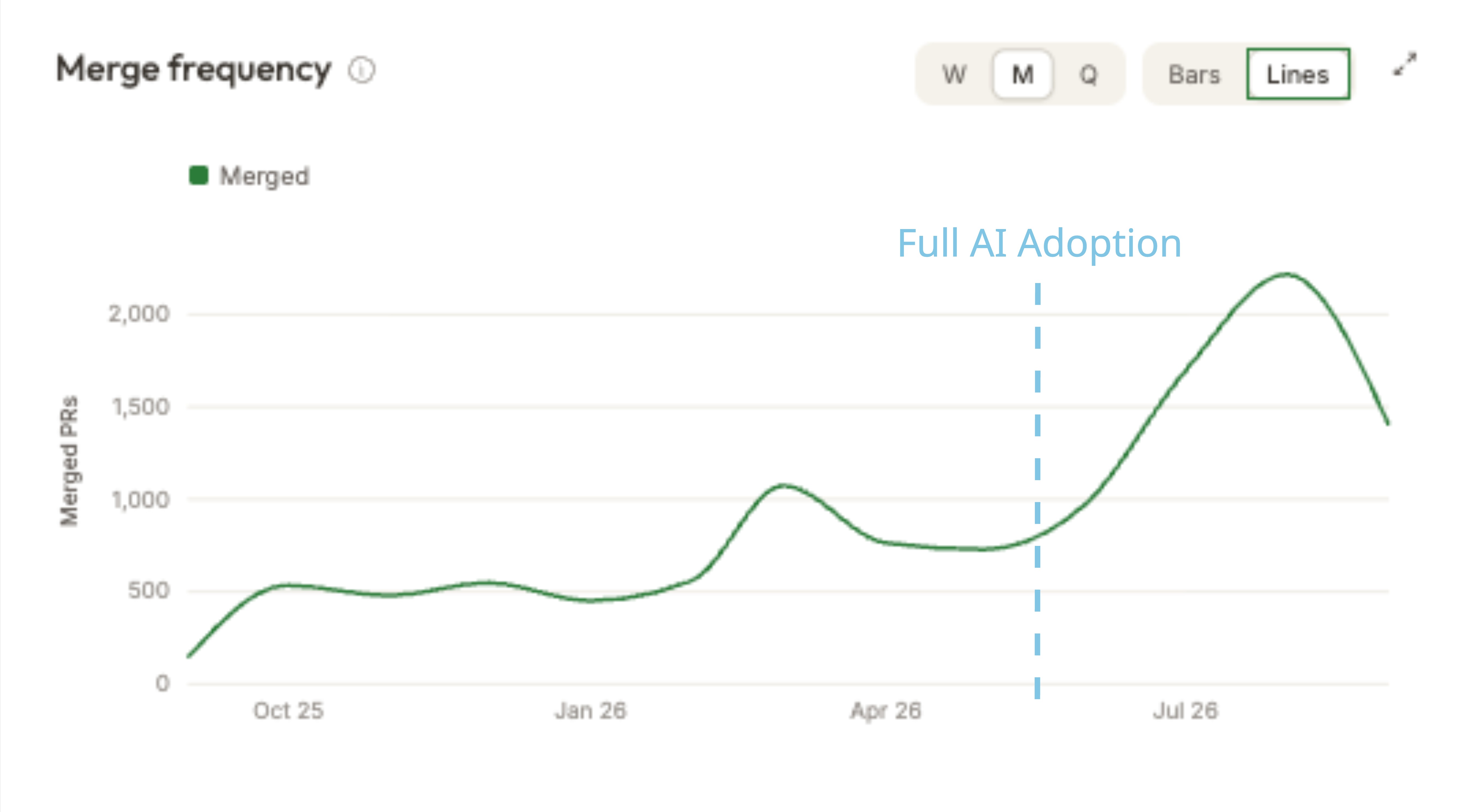
The Paradox of Fast Code: Why Software Velocity is Breaking Under Its Own Weight
There’s no doubt that the software development lifecycle (SDLC) has been ripped apart by AI Development tools, it’s not hard anymore to write code, but that doesn’t mean that it’s quick and easy to build the correct quality product. All software development companies are adapting and changing their way of working or even roles to this new norm. Yet, people still feel that building quality software isn't as fast as it should be even with the help of AI tools.
Why? Well the bottleneck has simply shifted, but not just left or right, it’s now at various stages of the SDLC. Coding isn't a bottleneck anymore. Understanding, validating, and aligning on what was just built is. There was always friction in these areas, but now its hurting more than ever. We still need to build a functional product that makes customers go wow, rather than a Frankenstein monster of lots of quickly created amazing functionality that are flakey or don’t fully work together.
"When a developer writes code from scratch, the friction and effort force them to build a mental model along the way. AI code works, but the shared understanding of how the system behaves is missing. AI agents accelerate cognitive debt." - Martin Fowler
So welcome to the Paradox of Fast Code. When code generation drops to seconds, the friction simply flows everywhere else. At Comper, we believe this results in Dark Code: a massive volume of machine-generated software that outpaces our human ability to formulate a coherent product, or to even review, secure, and maintain it.
Fast code: The New Friction Points
The Meeting Spiral: in my 25+ years I’ve noticed one common theme… engineers hate meetings of endless discussions. And now with coding taking minutes, the bottleneck has flipped upstream to planning meetings, forcing them into their unhappy space. But this isn’t just an engineering issue, it’s affecting everyone.
Customers are telling us that they are at least having an additional meeting per day to discuss implementation before doing anything and recent industry analysis indicates that increasing daily meeting frequency from 2 to 3 sessions slashes an engineer's probability of achieving meaningful daily progress from 74% to just 14%. PMs, architects, and devs spend hours in sync calls just trying to agree on system state before anyone touches an AI prompt.
The "Army of Juniors" Security Problem: AI tools prioritize plausible code over secure systems. Stanford researchers found developers using AI coding assistants actually produce more security vulnerabilities while remaining more confident that their code is safe. Without guardrails, AI assistants quietly inject exposed credentials, SQL vulnerabilities, and deprecated packages straight into your main branch.
Reviewer Burnout: Recent analysis in The Pragmatic Engineer highlights how Pull Request (PR) review times have exploded for AI-heavy teams. Senior engineers are drowning in massive PRs full of subtle logic bugs and duplicated code (which GitClear reports has surged 8x since AI tools exploded).
AI Hallucinations in the Dark: Generic AI coders operate on isolated files. Lacking a map of your broader system architecture, they make blind assumptions that create hidden technical debt across microservices.
But Now The Real Business Tax
But this isn’t just affecting engineers. It affects the whole production line of software development and those involved. Therefore, it is hitting a lot of businesses hard with the effort and time to spend addressing it.
Wasted Sprints on Unviable Specs: Engineers prompt an AI for days on a new feature, only to discover mid-build that it breaks existing core system contracts. Also, as it’s never been easier to build something, it doesn’t mean that it’s the correct thing to build for the business needs.
Payroll Burned on Coordination: Your highest-paid tech leads spend half their week doing "code archaeology" and sitting in alignment calls instead of building high-leverage software.
Fixing Mistakes at 30x the Cost: Catching architectural and security flaws in production costs up to 30x more than catching them in design. Fast code without continuous context just inflates your Total Cost of Ownership.
Enter Comper: The Continuous Context Layer
Instead of dumping more unverified code into your repos, Comper fixes the root problem: comprehension, feasibility, and automated guardrails at AI speed.
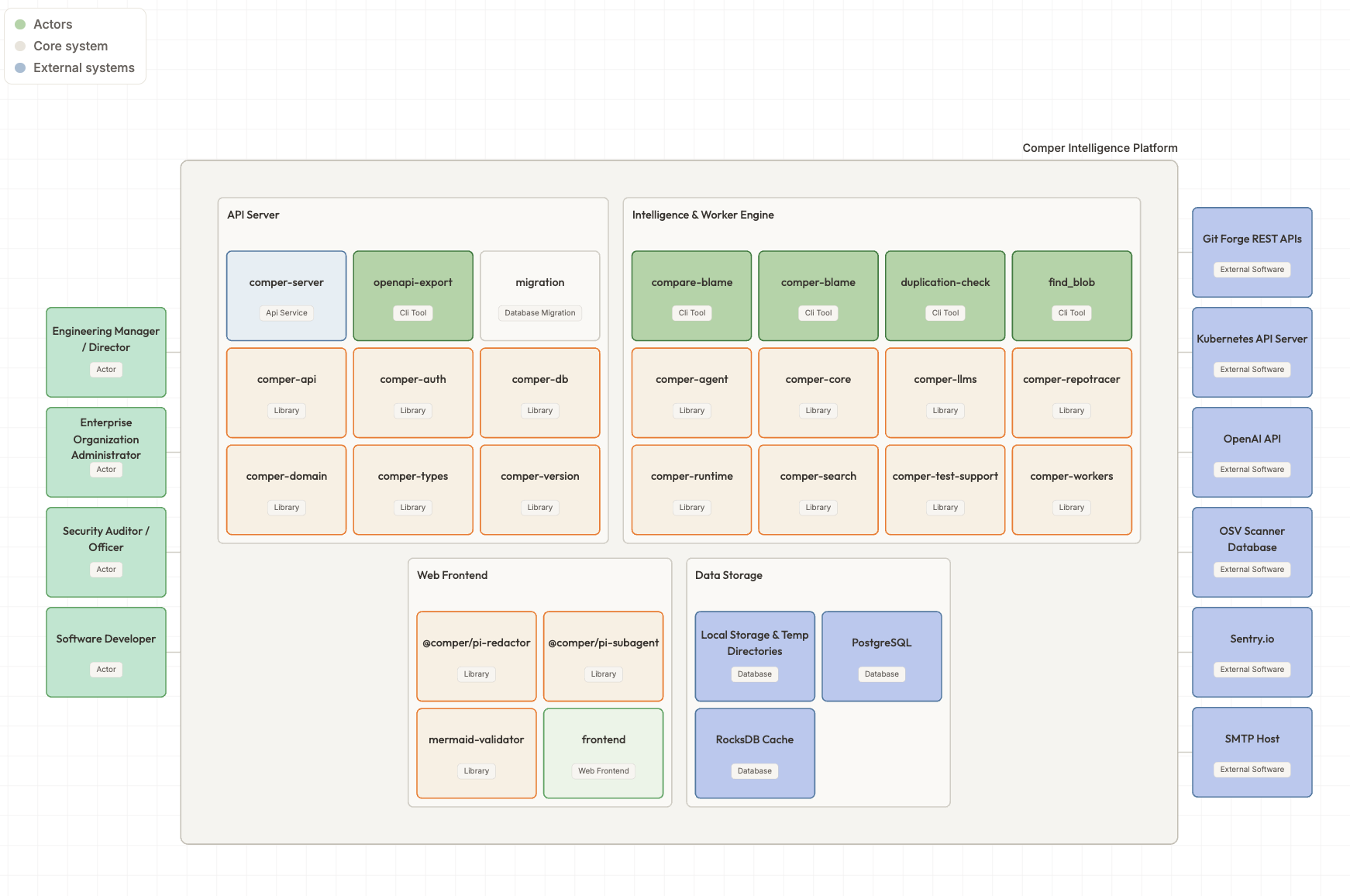
Comper acts as a collaborative continuous context engine that ingests your entire software estate, code, commit history, dependencies, and team ownership, and turns it into a living, queryable context layer for both humans and AI agents at every part of the SDLC.
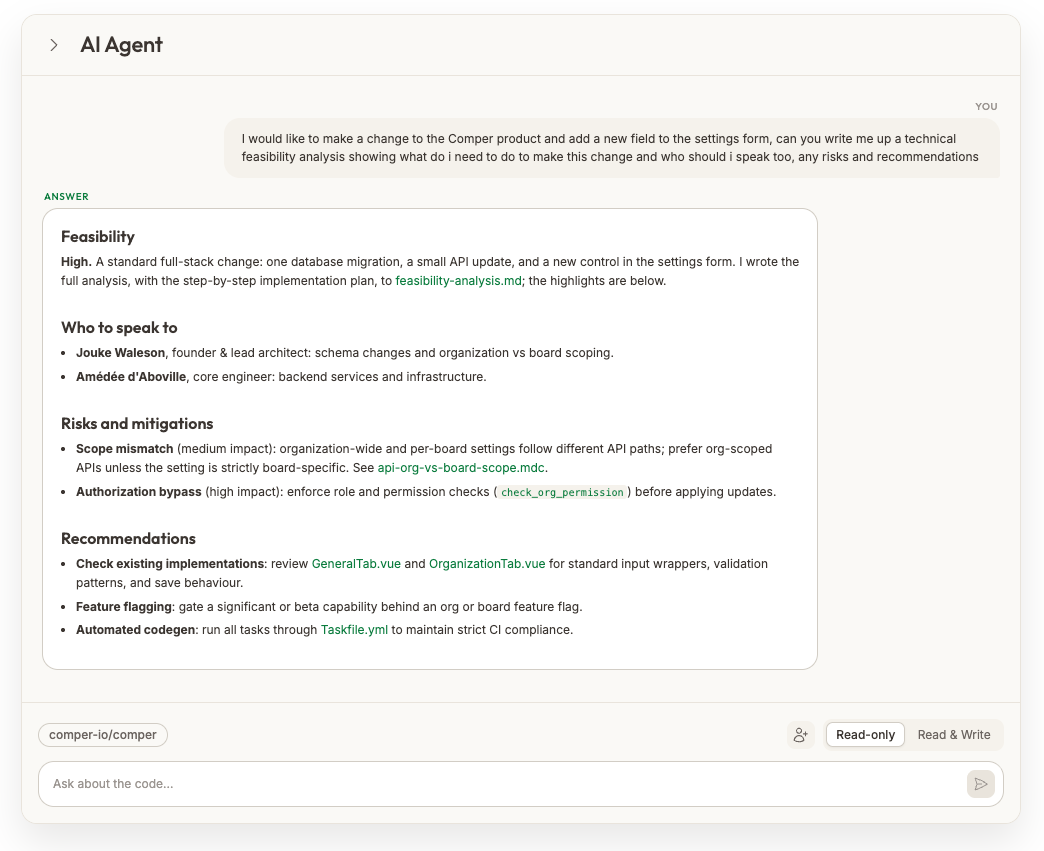
Feasibility Analysis Before You Build: Product Managers - Before wasting developer hours, creating meeting after meeting or splashing out on AI tokens, Comper suggests what proposed changes will need to get them done correctly. It instantly surfaces prerequisites, key people, flags breaking API changes, and calculates risk scores to prove a feature is viable upfront and reduces the team to implement.
Automated Security & Vulnerability Buffer: Comper continuously runs automated CVE scanning, secret detection, and multi-language complexity checks, catching AI-generated security flaws before they ever touch production.
Replaces Alignment Syncs with Living Maps: Automated, interactive system topology keeps PMs, architects, and engineers on the exact same page without needing another 45-minute planning meeting.
Instant Blast Radius Analysis: See exact dependency paths, security risks, and breaking changes visually before merging a PR, ending review fatigue for good.
Grounded AI Agents via MCP: Through the Model Context Protocol (MCP), Comper feeds complete software intelligence back into tools like Claude Code and Cursor. Your AI assistants stop guessing and start writing code grounded in your actual production geometry.
Who Wins with Comper?
Product Managers
Validate feature feasibility in minutes before sprint planning, eliminating mid-sprint surprises and reducing meeting overhead. Product Managers can ask the questions they want and find out who needs to be involved before kicking off longer alignment sessions with the wrong team members.
Engineers & Reviewers
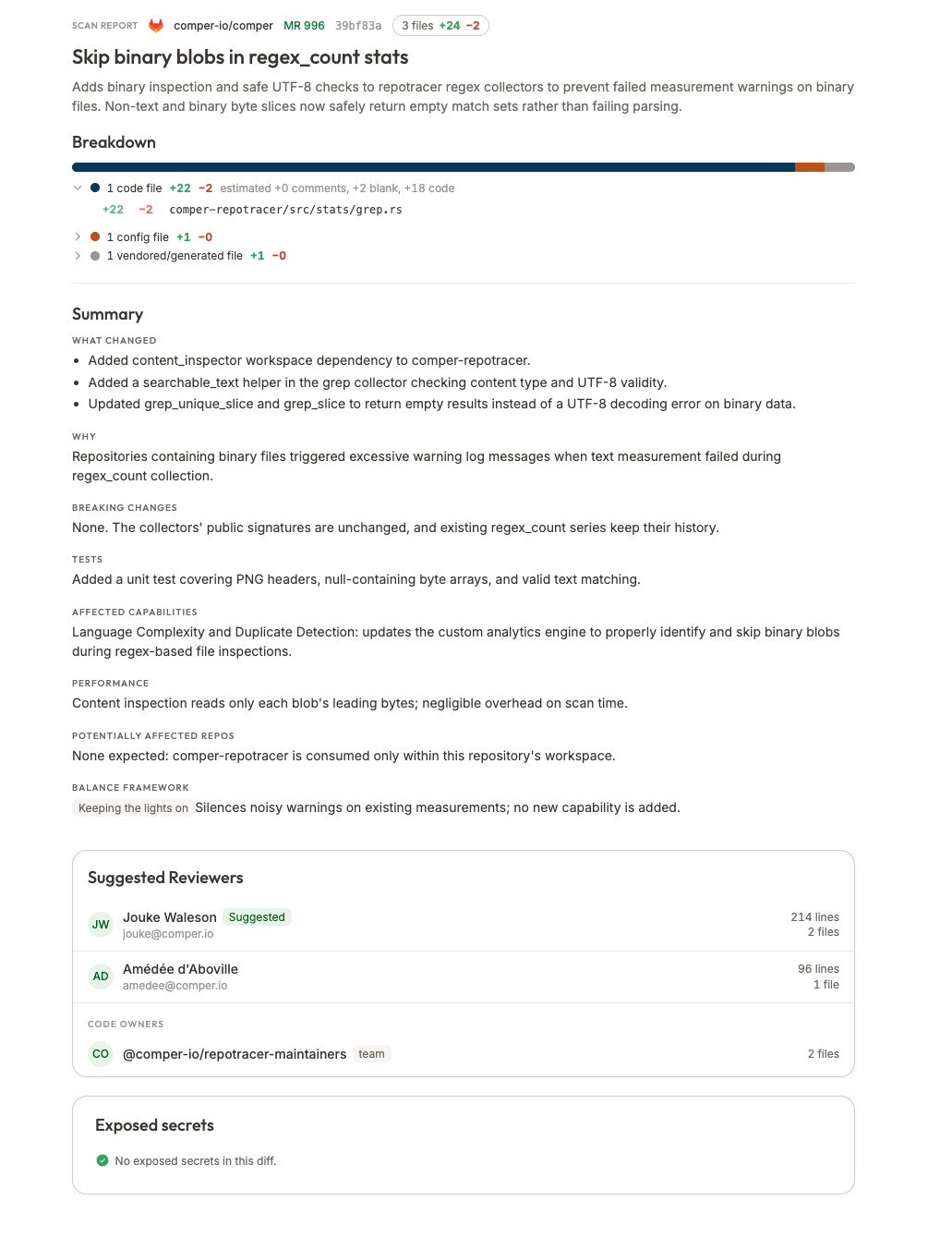
Realtime Pull Request Summaries, created within a second of the PR being made. Review PRs confidently by seeing exact cross-service impact and automated security checks instantly. Comper shows the breakdown of lines of code per file type in the PR summary so you can really focus on the changes you care about. It highlights architectural changes, security risks and breaking changes. It also flags who is the best person in your business to review the changes.
Tech Leads & Architects
Keep system diagrams updated automatically with every commit while stopping AI-driven architectural drift in its tracks.
Product and Engineering Leaders
Reclaim burned payroll, protect production from AI security vulnerabilities, and present clear business goals and metrics to the C-suite as we translate the realities of the tech to the organization's product flows.
We are in the midst of a generational shift. While I still believe that the foundational concepts of the SDLC remain sound, our execution must adapt. Anthropic recently published their AI-Native SDLC Playbook and they also highlighted this bottleneck shift, urging teams to pass markdown specs between AI agents to help evolve the SDLC way of working. But I believe that passing static documents isn't enough. Fast coding without shared context isn't speed, it's high-interest cognitive debt. Before we used humans to enable and facilitate the processes with their onboarded knowledge, but we simply can’t keep up and help as much now.
We have to be aware that fast coding without shared context isn't speed, it's fast-tracked cognitive debt and security exposure. Comper brings clarity back to software engineering, letting product and engineering teams evaluate feasibility upstream, secure code continuously, and ship safely downstream.