Why Microservices Ownership Breaks Down at Scale
Microservices ownership breakdowns occur when architectural complexity outpaces team visibility. Organizations scaling beyond 100 services often lose track of dependencies, leading to broken deployments and security vulnerabilities. The solution is not reverting to monoliths, but implementing a visibility layer that automates service mapping, ownership tracking, and risk analysis.
Microservices ownership breakdowns occur when architectural complexity outpaces team visibility. Organizations scaling beyond 100 services often lose track of dependencies, leading to broken deployments and security vulnerabilities. The solution is not reverting to monoliths, but implementing a visibility layer that automates service mapping, ownership tracking, and risk analysis.
Your two-hundredth microservice just went live. Congratulations. But right now, there's a pull request sitting in someone’s queue, and if you asked around, nobody could tell you which twelve downstream services will break the moment it merges.
This isn't a failure of your review process or your engineers. It’s what happens when your architecture outpaces your ability to see inside it. You've scaled, but your understanding of that scale hasn't kept up.
Why Microservices Adoption Trends are Cooling
We’re seeing a shift across the board. The 2025 CNCF survey shows that 42% of organizations are pulling back, consolidating microservices into "modular monoliths," though many architects argue that microservices will become essential as AI-driven coding generates more services that require distinct boundaries for maintenance and debugging. Many cite regret over the complexity and costs they've inherited. Even service mesh adoption, the barometer for managing service-to-service communication, has plummeted from 18% to 8% in just two years. Thoughtworks is tracking the same cooling trend.
But look closer at the data. This isn't a story of microservices failing as a concept. It's the story of companies moving into a distributed world without building the visibility layer to manage it. You can't own what you can't see.
Why Microservices Dependencies Fail at Scale
Microservices arrived with a massive promise: total independence. Small teams, separate deployments, and zero bottlenecks. And at 20 services, with the original authors still responsible for their own services, that promise feels real. It works and helps drive the shift-left mentality.
Then you hit 100 services. Teams re-organize. The engineers who built the foundation move on, and new hires inherit code they didn't design. Suddenly, the clean lines of your org chart no longer match the messy reality of your service map. By 200 services, the two are completely unrecognizable to each other and nobody understands the intern-connections and dependencies anymore .
This doesn't happen overnight. It’s a slow drift, one service and one team shuffle at a time, until you realize you’ve lost the map entirely.
The Operational Risks of Blind Code Reviews
The breakdown of manual code reviews creates significant operational friction:
When you have a few services, a lead developer can hold the whole system in their head. But as you scale, that "mental map" breaks. Reviews either turn into a rubber stamp because nobody has the context to challenge them, or they become a massive bottleneck while waiting for the one person who understands the blast radius to return from leave.
The result? Breaking changes ship because nobody could see them coming. It’s not that your team isn't looking; it's that they literally can't see the impact.
This is also where security risk hides. In a system moving this fast with review context this thin, a leaked secret or an exposed credential is just one "LGTM" away from production.
The Answer Isn't Fewer Services, It’s Better Sight
Consolidating back into monoliths is a popular response right now, but for many, it's just treating the symptom. The core problem remains: your architectural understanding didn't scale. If you don't fix the visibility gap now, it will just come back to haunt you the next time you grow.
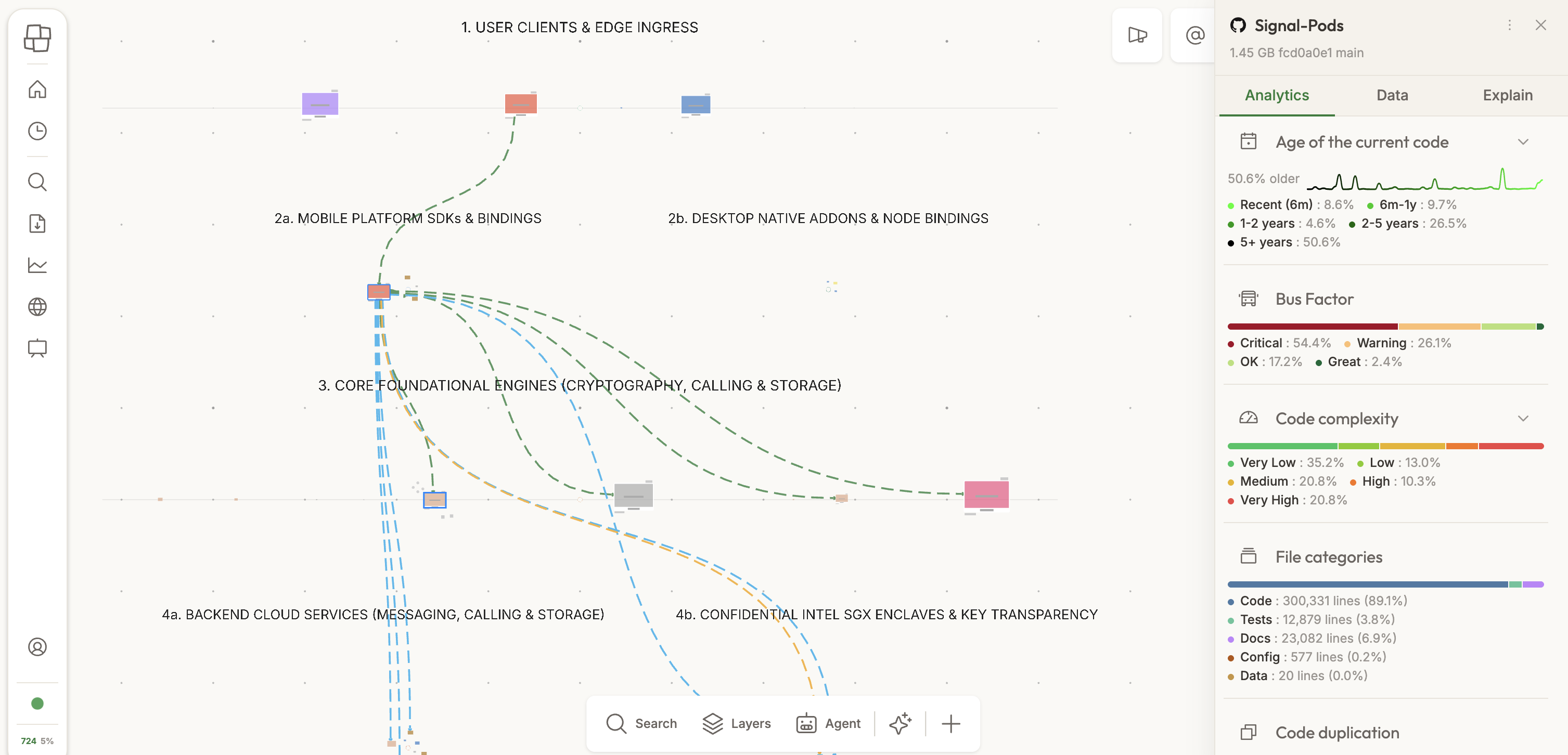
The durable solution is a visibility layer that lives alongside your code. You need a system that automatically knows what’s changing, what it touches, and exactly who is qualified to review it. Not just for the repo being touched, but a context layer that knows about everything it’s connected to.
Where Comper fits
This is exactly why we built Comper. Our Continuous Pull Request Scanning turns every pull request into a human-readable risk analysis. We show you the "what if" before you merge: what will this touch, where is the risk, and what breaks? We route reviews to the experts, not just whoever is available, and catch leaked secrets in real-time before they leave the diff.
With Comper's git platform integrations (including GitHub, GitLab, and Bitbucket), that visibility covers your entire organization. Connect it once, and every commit across every repository is surfaced and tracked. It doesn't matter how many repos you have; you get a single source of truth for your whole estate.
We also tackle the "invisible" tech debt. Comper highlights thin test coverage and outdated dependencies and architectural risks across your entire system, ranking them so you know exactly what needs your attention first.
The ownership concern or historical knowledge silo and gaps risks of microservices is addressed by Comper in real-time as we map the contributors and owners to each service, even as the business evolves.
You shouldn't have to choose between microservices architecture and peace of mind. You just need visibility that scales as fast as you do.
See it for yourself at getcomper.ai
Frequently Asked Questions
Find answers to common questions about Comper
How does scaling microservices lead to technical debt?
In a monolith, debt is in one place. In microservices, it’s everywhere. Because no one person sees the whole system, issues like outdated dependencies and weak tests stay hidden until a service fails in production.
What causes technical debt in microservices architectures?
The 2025 CNCF survey shows 42% of teams are consolidating back to modular monoliths due to complexity and cost. The issue isn't the architecture; it's that they grew faster than their ability to track dependencies.
How do you effectively track service ownership at scale?
Manual tracking fails as you grow. The reliable way is through automation: tools that map impacts in real-time and route reviews to the right experts automatically.